
Calculate Overtime Calculator
Enter the hours you worked each day and your hourly rate. The calculator splits them into regular, overtime and double-time hours using federal weekly rules or daily overtime rules such as California's, and shows your gross pay for the week.
- Free to use
- No sign-up
- Runs in your browser
Calculate overtime pay
Overtime & Timesheet Workbook
Track a whole year of hours with automatic weekly overtime and gross pay, plus printable timesheets.
- Weekly overtime workbook (XLSX, PDF)
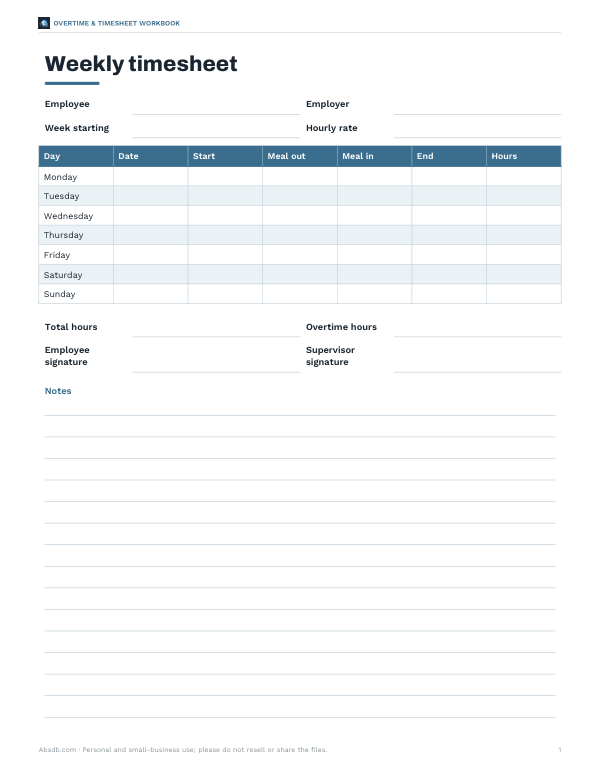
- Printable daily timesheet (PDF, DOCX)
Formats: XLSX, PDF, DOCX. Instant download after payment (link valid 72 hours, up to 5 downloads). AI-assisted: the templates were drafted with AI help and reviewed and laid out before publishing.
$4.00 USD, one-time
- Instant download
- 7-day refund
- Secure checkout by Stripe
7-day money-back guarantee. Full refund within 7 days of purchase, even after you download.
Full refund within 7 days — see the refund policy and license.
Free printables
Single sheets you can print right now, no sign-up. The full pack adds every sheet in one download plus the editable files.
How overtime is calculated
Under the federal Fair Labor Standards Act (FLSA), covered non-exempt employees must be paid at least one and a half times their regular rate for hours worked over 40 in a workweek. A workweek is a fixed, recurring period of 168 hours — seven consecutive 24-hour days — set by the employer; it does not have to start on Monday. Each workweek stands alone: hours cannot be averaged over two weeks.
- Add up all hours worked in the workweek.
- Hours up to 40 are regular hours; hours above 40 are overtime hours.
- Straight-time pay = hourly rate × all hours worked (plus any non-discretionary bonus).
- Overtime premium = 0.5 × regular rate × overtime hours.
- Gross pay = straight-time pay + overtime premium.
Splitting pay this way — straight time on every hour plus a half-time premium on overtime hours — gives exactly the same answer as paying 1.5 × rate for overtime hours when there are no bonuses, and it is how bonuses are handled correctly.
Daily overtime rules
Some states add daily overtime on top of the weekly rule. The best-known is California, where non-exempt employees generally earn:
- 1.5 × the regular rate for hours over 8 in a workday, and for the first 8 hours on the seventh consecutive day worked in a workweek;
- 2 × the regular rate for hours over 12 in a workday, and for hours over 8 on the seventh consecutive day;
- 1.5 × for hours over 40 in the workweek that were not already paid as daily overtime.
Alaska and Nevada also have daily overtime rules in some circumstances, and Colorado requires overtime after 12 hours in a workday. Rules can differ for alternative workweek schedules, certain industries and collective bargaining agreements. The “Daily over 8 + weekly over 40” option applies a simple daily-8 rule without California's seventh-day and double-time provisions.
What counts toward the regular rate
The overtime premium is based on the “regular rate”, which is not always the base hourly rate. Non-discretionary bonuses — ones promised in advance for productivity, attendance or hitting targets — and shift differentials generally must be included. The regular rate for the week is total straight-time compensation divided by total hours worked. Discretionary gifts, some expense reimbursements and premium pay already paid as overtime are excluded. Enter a weekly bonus in the calculator to see the effect: it raises the regular rate and therefore the overtime premium.
Worked example
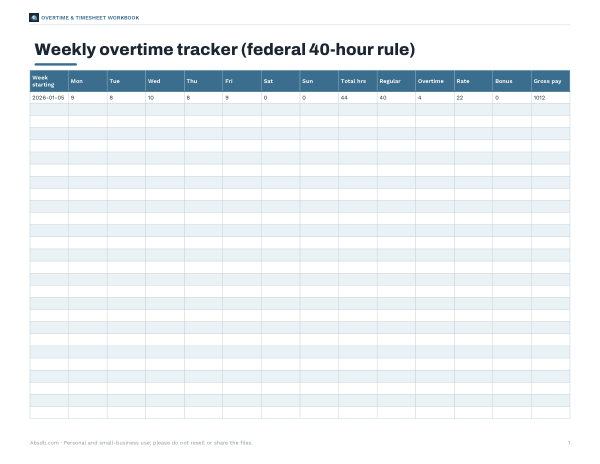
You earn $22 an hour and work 9, 8, 10, 8 and 9 hours Monday to Friday — 44 hours. Under the federal weekly rule, 40 hours are regular and 4 are overtime. Straight-time pay is 44 × $22 = $968, and the overtime premium is 4 × $11 = $44, for gross pay of $1,012. Under California's daily rule, Monday gives 1 hour of daily overtime, Wednesday 2 and Friday 1 — the same 4 hours in this case. If you had worked 12 hours on Wednesday and 6 on Thursday instead, daily overtime would be 4 hours even though the week totals the same 44 hours.
Who is entitled to overtime
Overtime rules apply to non-exempt employees. Some salaried employees in executive, administrative or professional roles are exempt if they meet both the duties tests and the minimum salary level set by federal rules (and sometimes a higher state level). Independent contractors are not covered by the FLSA, but misclassification is common. If you are unsure whether you are exempt, look at your actual duties rather than your job title, and ask your state labor department or the US Department of Labor's Wage and Hour Division.
Tracking your hours accurately
- Record start time, end time and unpaid meal breaks every day.
- Include time spent on required work before or after your shift, such as opening duties, security checks or required training.
- Short rest breaks (typically up to 20 minutes) are generally counted as paid time under federal rules.
- Round consistently: employers who round must do it neutrally, not always in their own favour.
- Keep your own records alongside your employer's timesheet in case of a discrepancy.
Time-and-a-half at common hourly rates
| Hourly rate | Overtime rate (1.5×) | Double time (2×) | Pay for 5 OT hours |
|---|---|---|---|
| $15.00 | $22.50 | $30.00 | $112.50 |
| $18.00 | $27.00 | $36.00 | $135.00 |
| $20.00 | $30.00 | $40.00 | $150.00 |
| $25.00 | $37.50 | $50.00 | $187.50 |
| $30.00 | $45.00 | $60.00 | $225.00 |
If you think your overtime was underpaid
Start by comparing your own hour records with your pay stub for the workweek in question, and check whether a bonus or shift differential was left out of the regular rate. Many errors are simple payroll mistakes that a polite written question to your manager or HR resolves. If not, the US Department of Labor's Wage and Hour Division and most state labor departments accept complaints, generally without charge, and there are time limits for recovering unpaid wages, so do not wait too long. This calculator is an estimate to help you understand the numbers; it is not legal advice.
Frequently asked questions
Is overtime paid after 8 hours a day?
Under federal law, no — only after 40 hours in a workweek. Some states, including California, require daily overtime.
What is time and a half for $20 an hour?
$30 an hour for each overtime hour.
Do paid holidays or sick days count toward 40 hours?
Under federal law, hours not actually worked usually do not count toward overtime unless your employer's policy or a contract says they do.
Can my employer average hours over two weeks?
Not under the FLSA. Each workweek is calculated separately, even if you are paid every two weeks.
Is this calculator legal advice?
No. It estimates gross pay from common rules. Your employer, contract or state law may differ.